Rating: 5 out of 5
Legit
Wojciech ·
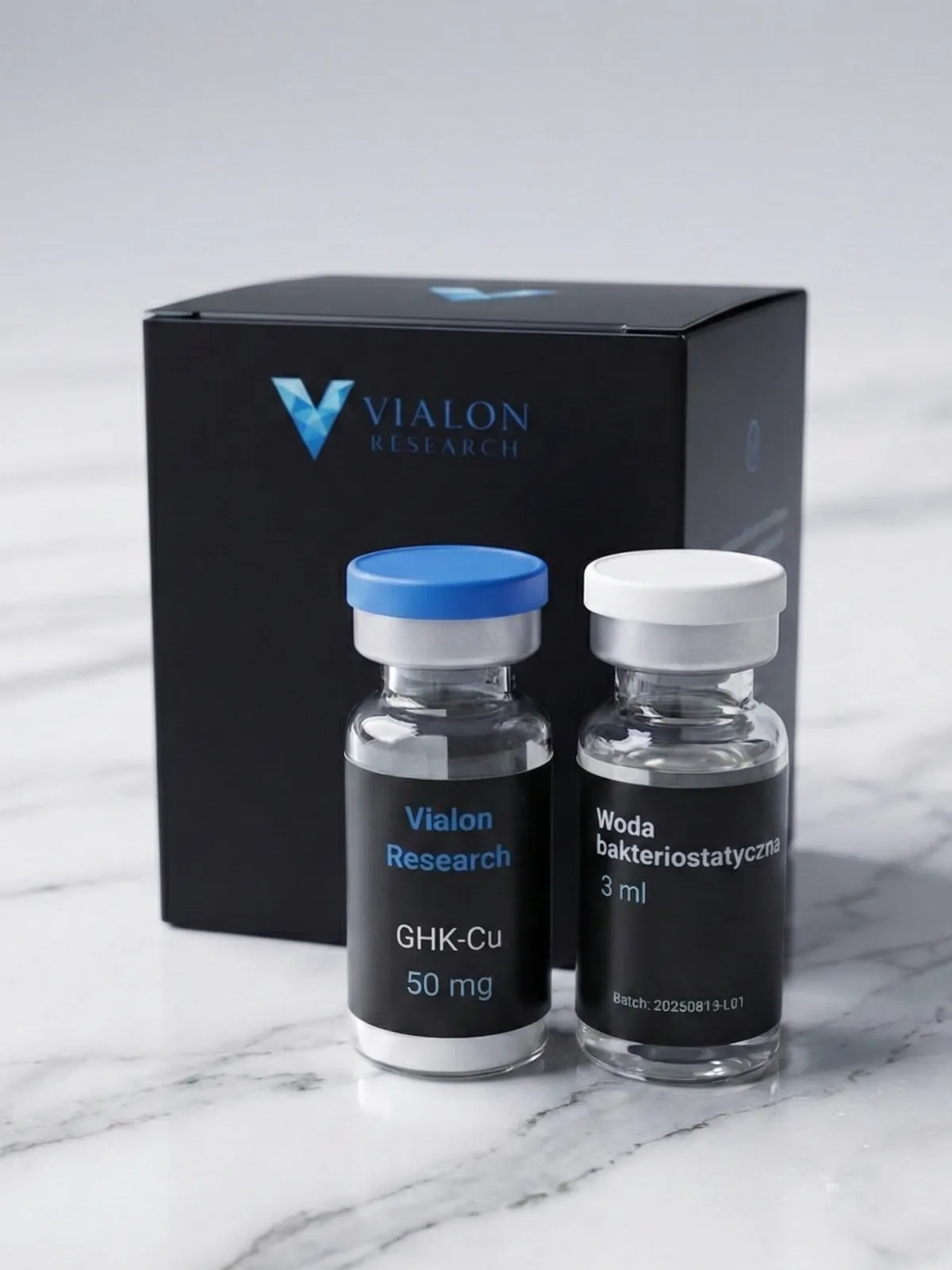
Copper tripeptide · 3 amino acids
5.0/5 · 3 reviewsPLN 149.00
Gross price, 23% VAT included
Wyłącznie do celów badawczych. Nie do użytku ludzkiego.
For research use only. Not for human use.
| Parameter | Value |
|---|---|
| Molecular formula | C₁₄H₂₃CuN₆O₄ |
| Molecular weight | ~403.9 Da |
| Amino acid count | 3 (tripeptide) |
| Sequence | Gly-His-Lys·Cu²⁺ |
| CAS number | 89030-95-5 |
| PubChem CID | 73587 |
| Physical form | Blue lyophilized powder |
| Purity | ≥98% (RP-HPLC) |
| Classification | Chemical reagent / research material |
| Intended use | For in vitro research use only, not for use in humans or animals |
Not classified as a hazardous substance under CLP regulation. Offered as a chemical reagent for in vitro laboratory use, within the framework of applicable European Union chemical substances regulations (REACH, CLP).
Reconstitution and storage conditions:
Typical analytical equipment:
All working parameters should be selected according to the research laboratory's internal protocol. Product intended exclusively for in vitro and analytical use; not for human or animal use.
GHK-Cu (Gly-His-Lys·Cu²⁺) is a naturally occurring copper tripeptide, first isolated from human plasma albumin by Loren Pickart in 1973. The three amino acid residues (glycine, histidine, lysine) form a stable chelate complex with a Cu²⁺ ion, with a molecular weight of approximately 401.9 Da. The imidazole ring of the histidine residue plays a key role in copper coordination.
GHK-Cu occurs physiologically in blood plasma, saliva, and urine of mammals. Research has shown that the concentration of this tripeptide in human plasma decreases with age. It is one of the few peptides in which the metal ion constitutes an integral part of the biologically active complex, rather than merely serving as an enzymatic cofactor.
The primary function of the GHK-Cu complex studied in in vitro models is delivery of Cu²⁺ ions to cells. Copper serves as a cofactor for key enzymes: lysyl oxidase (collagen and elastin cross-linking), superoxide dismutase (SOD), and cytochrome c oxidase.
In fibroblast culture studies, GHK-Cu has been shown to modulate expression of numerous genes related to the extracellular matrix. Increased expression of type I and III collagen, elastin, and glycosaminoglycans was observed, along with simultaneous decrease in matrix metalloproteinase activity (MMP-1, MMP-2). Stimulation of decorin expression, a proteoglycan with antifibrotic properties, and modulation of TGF-beta superfamily signaling were also noted.
Cytokine profiling studies in cell cultures demonstrated that GHK-Cu reduces levels of pro-inflammatory factors, including TNF-alpha and IL-6. These observations serve as a starting point for further research into the immunomodulatory properties of this copper tripeptide.
The GHK tripeptide was first described by Pickart and Thaler in Nature New Biology (1973) [1]. The authors isolated a peptide factor from human plasma albumin capable of prolonging hepatocyte survival in cell culture. This foundational work established GHK as a biologically active peptide with significant research potential.
Pickart, Vasquez-Soltero, and Margolina (2015) published a comprehensive review in BioMed Research International [2], demonstrating that GHK regulates expression of over 4,000 genes in human fibroblasts, including genes for collagen, elastin, fibronectin, metalloproteinases, and pro-inflammatory cytokines. The scope of gene regulation makes GHK-Cu one of the most broadly active signaling peptides identified to date.
In rat model experiments, accelerated wound closure, increased collagen synthesis, and intensified angiogenesis in the damaged area were observed following GHK-Cu administration [3]. These findings were consistent across multiple independent studies.
In fibroblast cultures, GHK-Cu reduces expression of MMP-1 and MMP-2 while simultaneously increasing expression of decorin, an endogenous fibrosis inhibitor, which correlated with improved extracellular matrix organization [2].
GHK-Cu is supplied as a lyophilized powder with purity above 98% (RP-HPLC). Store the lyophilized powder at -20°C to -80°C in a sealed container, protected from moisture and light. After reconstitution in sterile water, the solution remains stable for up to 30 days at 2-8°C. The presence of copper(II) ion in the complex makes the peptide sensitive to strongly reducing environments. Avoid repeated freeze-thaw cycles.
GHK-Cu is one of the most extensively studied peptides in the context of peptide-metal interactions. As a tripeptide with a mass of only ~403.9 Da, it is the shortest peptide in our catalog. Practical guidelines for storing lyophilized peptides and solutions are available in our knowledge base.
Selected publications on copper tripeptide GHK-Cu.
1. Pickart L, Thaler MM (1973)
„Tripeptide in human serum which prolongs survival of normal liver cells and stimulates growth in neoplastic cells"
Nature New Biology, 243:85-87
2. Pickart L, Vasquez-Soltero JM, Margolina A (2015)
„GHK Peptide as a Natural Modulator of Multiple Cellular Pathways in Skin Regeneration"
BioMed Research International, 2015:648108
3. Pickart L, Margolina A (2018)
„Regenerative and Protective Actions of the GHK-Cu Peptide in the Light of the New Gene Data"
International Journal of Molecular Sciences, 19(7):1987
GHK-Cu (Copper Tripeptide-1) is a naturally occurring copper tripeptide consisting of glycine, L-histidine, and L-lysine, forming a stable chelate complex with copper(II) ion. It was first isolated from human plasma albumin in 1973 by Loren Pickart.
The characteristic blue color of the lyophilized powder comes from the copper(II) ion complexed with the peptide. This is an authenticity marker — pure GHK-Cu always has a blue tint. A colorless powder would indicate absence of the copper ion in the complex.
We offer GHK-Cu in a 50 mg amount as a lyophilized powder, supplied in a hermetically sealed glass vial containing the peptide-copper complex.
Store the lyophilized powder at -20°C to -80°C, protected from light. After reconstitution in sterile water, store at 2-8°C and use within 30 days. Avoid contact with strong reducing agents.
Key publications include Pickart (1973, discovery from human plasma), Pickart & Margolina (demonstrating regulation of over 4,000 gene sequences), and numerous publications in Archives of Biochemistry and Biophysics. GHK-Cu is one of the most studied copper peptides in scientific literature.
5.0/5 · 3 reviews
Legit
Wojciech ·
Kontakt ze Sprzedawcą w pełni profesjonalny. Obsługa uprzejma, rzetelna i kompetentna. Z pełnym przekonaniem polecam zarówno Sprzedawcę, jak i produkty oferowane na stronie. Współpraca przebiegła bez zarzutu.
Marzena ·
Git
M.K ·
Your review will appear once our team has checked it. Your e-mail will not be shown publicly.
Gastric pentadecapeptide · 15 amino acids
Rated 4.7 out of 5 (3 reviews)
PLN 129.00
Thymosin beta-4 fragment · 43 amino acids
Rated 5.0 out of 5 (1 review)
PLN 149.00
Mitochondrial-derived peptide · 16 amino acids
No reviews
PLN 129.00
Mitochondrial tetrapeptide
No reviews
from PLN 130.00
GHK-Cu
PLN 149.00