Variability of HPLC and MS Laboratory Analysis Results
TL;DR: Laboratory analysis results can differ even for the same test material, because methods such…

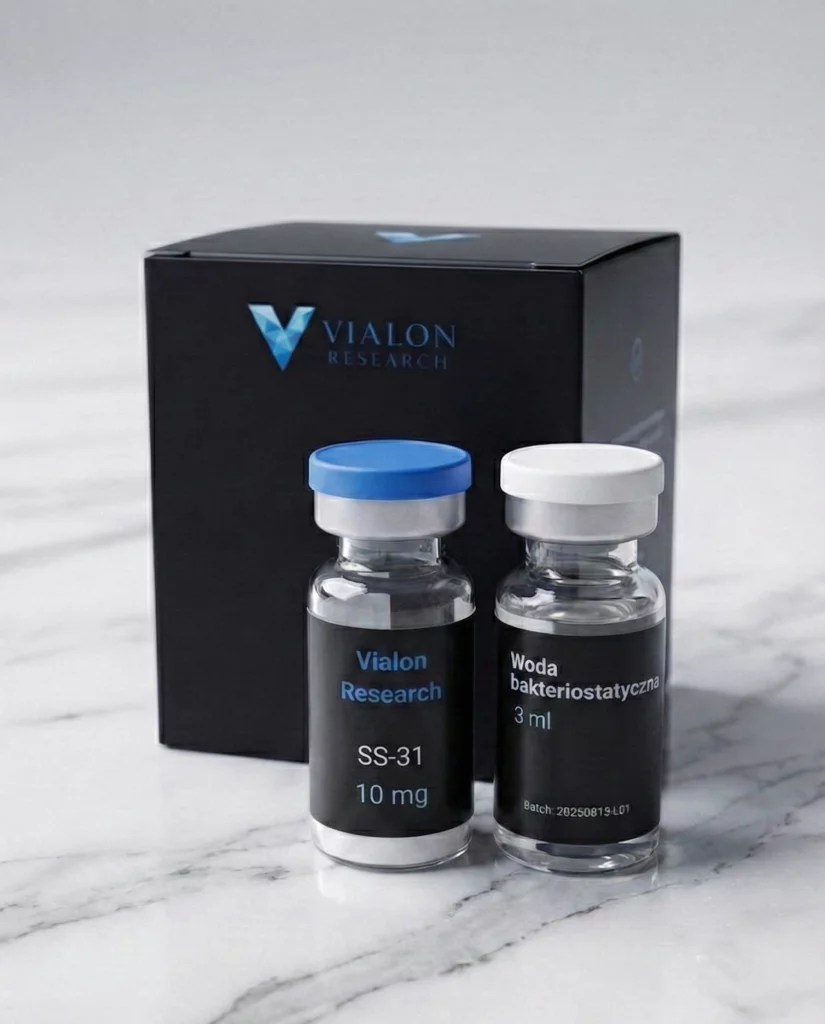
Mitochondrial tetrapeptide · CAS 736992-21-5
| Parameter | Value |
|---|---|
| Molecular formula | C₃₂H₄₉N₉O₅ |
| Molecular weight | ~639.8 Da |
| Amino acid count | 4 (tetrapeptide) |
| Sequence | D-Arg-Dmt-Lys-Phe-NH₂ |
| CAS number | 736992-21-5 |
| PubChem CID | 11764719 |
| Physical form | White lyophilized powder |
| Purity | ≥98% (RP-HPLC) |
| Classification | Chemical reagent / research material |
| Intended use | For in vitro research use only, not for use in humans or animals |
Not classified as a hazardous substance under CLP regulation. Offered as a chemical reagent for in vitro laboratory use, within the framework of applicable European Union chemical substances regulations (REACH, CLP).
Reconstitution and storage conditions:
Typical analytical equipment:
All working parameters should be selected according to the research laboratory’s internal protocol. Product intended exclusively for in vitro and analytical use; not for human or animal use.
SS-31 belongs to the Szeto-Schiller (SS) peptide family, rationally designed by Hazel H. Szeto and Peter W. Bhatt at Weill Cornell Medical College to selectively target mitochondria. The molecule consists of just four amino acid residues: D-Arg-Dmt-Lys-Phe-NH₂, where Dmt denotes 2',6'-dimethyltyrosine. The alternating aromatic-cationic motif is the key structural element enabling over 1000-fold accumulation of the peptide in mitochondria.
The molecular weight of SS-31 is only ~639.8 Da, making it one of the smallest mitochondria-targeted peptides. D-arginine at position 1 provides resistance to protease degradation. Dimethyltyrosine at position 2 is responsible for cardiolipin interaction. C-terminal amidation (-NH₂) protects the peptide chain from carboxypeptidases.
SS-31 selectively accumulates in the inner mitochondrial membrane (IMM), where it binds to cardiolipin, a phospholipid found almost exclusively in this structure. Cardiolipin stabilizes the organization of electron transport chain (ETC) supercomplexes and is essential for proper cytochrome c function.
In in vitro cellular models, binding of SS-31 to cardiolipin was shown to optimize electron transfer within the ETC, limiting electron leak and reactive oxygen species (ROS) production. Importantly, SS-31 does not act as a classical uncoupling protonophore: it does not dissipate the mitochondrial membrane potential (ΔΨm), but only improves electron flow efficiency.
This mechanism distinguishes SS-31 from "scavenger" type mitochondrial antioxidants (e.g., MitoQ), which neutralize already-formed ROS. SS-31 acts at an earlier stage, limiting the very process of excessive free radical generation at its source.
The Szeto-Schiller peptide family was described by Hazel H. Szeto in a review in AAPS Journal (2006, 8(3):E521-E531). The author presented the rational basis for designing peptides with alternating aromatic-cationic motifs that selectively accumulate in mitochondria [1].
Zhao, Zhao, Wu, et al. in Journal of Biological Chemistry (2004, 279(33):34682-34690) demonstrated that SS peptides penetrate cell membranes and accumulate in the inner mitochondrial membrane, inhibiting mitochondrial swelling and limiting cell death induced by oxidative stress [2].
Birk, Liu, Soong, et al. published in J Am Soc Nephrol (2013, 24(8):1250-1261) a key paper confirming direct SS-31 binding to cardiolipin. In a rat kidney ischemia-reperfusion model, they demonstrated restoration of mitochondrial bioenergetic efficiency through restabilization of ETC supercomplexes [3].
SS-31 has been studied in mouse and rat models of cardiac ischemia-reperfusion and kidney injury, with observed reduction in mitochondrial dysfunction. In aging mouse models, improved mitochondrial bioenergetic parameters were documented in tissues of aged animals [2,3].
SS-31 is a tetrapeptide with a mass of ~640 Da featuring several key modifications:
Selected publications on SS-31 (Elamipretide) and Szeto-Schiller peptides.
"Mitochondria-targeted peptide antioxidants: novel neuroprotective agents"
AAPS Journal, 8(3):E521-E531
"The mitochondrial-targeted compound SS-31 re-energizes ischemic mitochondria by interacting with cardiolipin"
Journal of the American Society of Nephrology, 24(8):1250-1261
This product is a chemical raw material intended exclusively for in vitro research, scientific, and analytical applications. It is not intended for human or veterinary use, including for diagnostic, therapeutic, prophylactic, or nutritional purposes.
This product is not classified as a hazardous substance under CLP Regulation (EC) No 1272/2008. It is offered as a chemical reagent within the framework of applicable European Union chemical substances regulations (REACH, CLP). It does not constitute a medicinal product, dietary supplement, medical device, or cosmetic within the meaning of applicable laws.
Unused material should be disposed of in accordance with local regulations on chemical waste. Under laboratory conditions: neutralize and dispose with laboratory waste streams. Do not discharge into sewage systems.
This product is offered in accordance with applicable European Union regulations on chemical substances (REACH, CLP) and Polish law governing the trade of chemical reagents and research materials. Full terms of sale and product classification are set out in the Terms of Service.
By placing an order, the Customer confirms having read the above information and accepts the provisions of the Terms.
For questions regarding handling or regulatory information: [email protected].
Verified customer reviews for this product
This product has no reviews yet
TL;DR: Laboratory analysis results can differ even for the same test material, because methods such…
TL;DRThis article explains how HPLC/MS is widely used as a set of laboratory analytical methods…
Reading a COA requires verifying the batch, analytical methods, acceptance criteria, and test results.
SS-31 (also known as Elamipretide or MTP-131) is a cell-permeable tetrapeptide belonging to the Szeto-Schiller peptide family. It selectively targets the inner mitochondrial membrane by binding to cardiolipin. CAS: 736992-21-5.
SS-31 has an alternating aromatic-cationic structure (D-Arg-Dmt-Lys-Phe-NH2) that enables it to cross cell membranes and concentrate 1000-5000x in mitochondria, where it binds to cardiolipin in the inner mitochondrial membrane.
Store lyophilized SS-31 at -20°C to -80°C, protected from light. After reconstitution, store at 2-8°C and use within 30 days.
SS-31 is available as a 10 mg lyophilized vial.
SS-31 and Elamipretide refer to the same tetrapeptide compound. SS-31 is the research designation from the Szeto-Schiller series, while Elamipretide is the INN (International Nonproprietary Name).