Disclaimer: The following article is for educational and informational purposes only. The substances described are intended for research and laboratory use only. This does not constitute medical advice or an encouragement to use in humans or animals.
Introduction
GHK-Cu (Gly-His-Lys·Cu²⁺) is a naturally occurring copper tripeptide first isolated from human plasma in 1973 by Loren Pickart. During experiments with plasma albumin fractions, Pickart observed that a small peptide with the sequence glycine-histidine-lysine restored the proliferative capacity of hepatocytes from elderly donors to levels comparable to young cells.
GHK-Cu occurs endogenously in blood plasma (~200 ng/mL in 20-year-olds), saliva, and cerebrospinal fluid. Its blood concentration declines with age — in individuals over 60, it drops to ~80 ng/mL. This natural metallopeptide has been the subject of intensive preclinical research for decades due to its ability to modulate thousands of human genes.
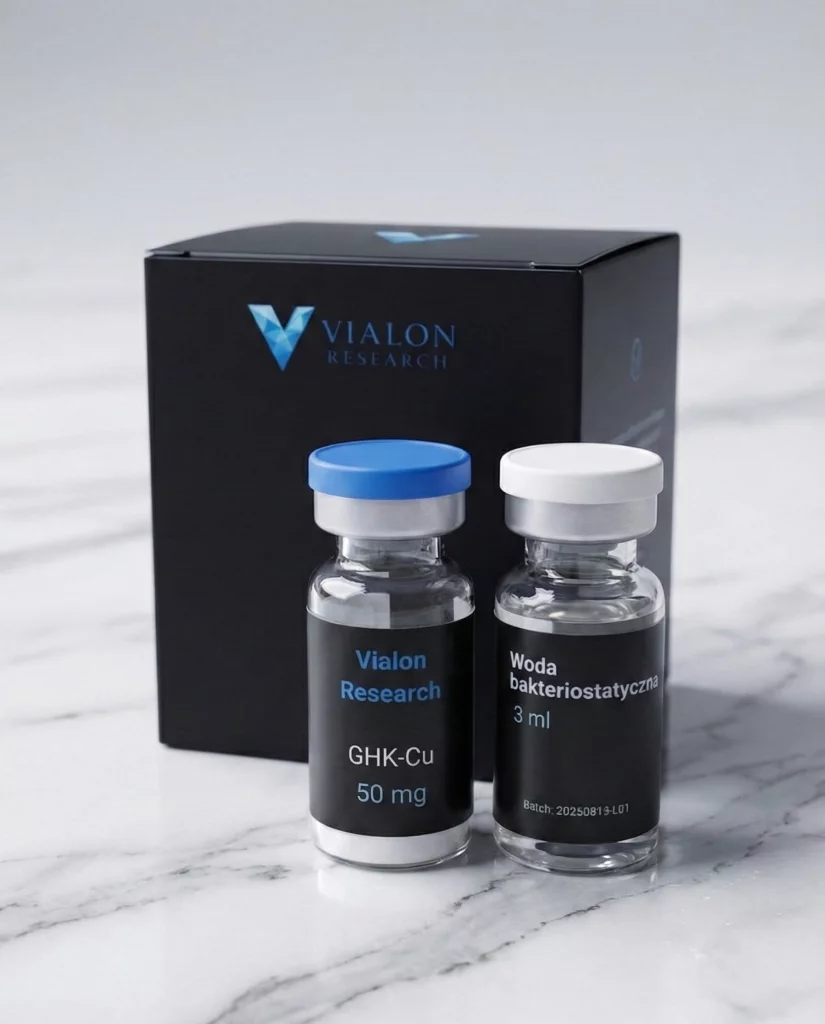
Our store offers research-grade GHK-Cu with purity confirmed by HPLC certificate of analysis (≥98%).
Molecular Structure and Copper Chelation
GHK-Cu is a metallopeptide complex with a mass of ~402 Da — significantly smaller than most biologically active peptides (BPC-157: ~1419 Da, TB-500: ~4963 Da). The sequence of three amino acids — glycine, histidine, and lysine — forms a structure capable of chelating the Cu²⁺ ion with high affinity.
Copper coordination in the GHK-Cu complex occurs through three binding points: the imidazole nitrogen of histidine, the amino group of lysine, and the nitrogen of the peptide bond. This coordination geometry ensures complex stability under physiological conditions (pH 7.4) while maintaining the ability to release Cu²⁺ ions in a controlled manner within the cellular environment.
The copper ion serves as an enzymatic cofactor for key enzymes:
- Superoxide dismutase (SOD1) — the primary antioxidant enzyme neutralizing superoxide anion radicals
- Lysyl oxidase (LOX) — an enzyme essential for crosslinking collagen and elastin in the extracellular matrix
- Cytochrome c oxidase (Complex IV) — the terminal electron acceptor in the mitochondrial respiratory chain
The characteristic blue color of GHK-Cu lyophilizate results from d-d electronic transitions of the Cu²⁺ ion in the ligand field — a feature typical of copper complexes with near-square-planar geometry.
Gene Expression Modulation
One of the most significant discoveries regarding GHK-Cu is its ability to modulate the expression of thousands of human genes. Analysis conducted by Pickart and Margolina (2018) using the Broad Institute Connectivity Map databases revealed that GHK affects the expression of over 4,000 genes — approximately one-sixth of the human genome.
Upregulated genes:
- TGF-β superfamily genes — key regulators of regenerative processes and tissue remodeling
- Collagen synthase genes — responsible for production of collagen types I, III, and IV
- DNA repair genes — including GADD45A and BRCA1
- Antioxidant enzyme genes — SOD, glutathione peroxidase, catalase
Downregulated genes:
- Proinflammatory cytokines: interleukin-6 (IL-6), tumor necrosis factor alpha (TNF-α)
- Matrix metalloproteinases: MMP-2 and MMP-9 — enzymes that degrade extracellular matrix components
- NF-κB pathway genes — the master regulator of the inflammatory response
The mechanism of GHK-Cu action does not rely on classical receptor-ligand binding. Proposed pathways include modulation via integrins (adhesion receptors on cell surfaces) and controlled delivery of copper ions into cells, where Cu²⁺ activates copper-dependent signaling cascades.
Research Areas
Extracellular Matrix Remodeling
The extracellular matrix (ECM) constitutes the structural scaffold of tissues. GHK-Cu demonstrates in vitro the ability to stimulate synthesis of key ECM components:
- Collagen types I and III — the main structural proteins of connective tissue
- Elastin — the protein responsible for tissue elasticity
- Glycosaminoglycans (GAGs) — including hyaluronic acid and chondroitin sulfate
- Decorin — a proteoglycan that regulates collagen fiber organization
In wound healing models, GHK-Cu activates fibroblasts — cells responsible for ECM synthesis — and accelerates angiogenesis (formation of new blood vessels). These properties place it in the class of regenerative peptides alongside compounds such as BPC-157 (gastric pentadecapeptide), although the mechanisms of action of both peptides are distinct.
Antioxidant Properties
GHK-Cu exhibits multi-level antioxidant activity that extends beyond simple free radical neutralization:
- Antioxidant enzyme induction — increased expression of superoxide dismutase (SOD) and glutathione peroxidase, constituting the first line of cellular defense against oxidative stress
- Reactive carbonyl aldehyde scavenging — GHK-Cu binds acrolein and 4-hydroxynonenal (4-HNE), lipid peroxidation products with strong cytotoxic effects
- Ferritin induction — increased ferritin synthesis leads to sequestration of free iron, limiting the Fenton reaction (Fe²⁺ + H₂O₂ → Fe³⁺ + OH· + OH⁻), which generates highly reactive hydroxyl radicals
This three-tier mechanism — antioxidant enzymes, aldehyde scavenging, iron sequestration — makes GHK-Cu one of the more complex antioxidant peptides studied in the context of oxidative stress.
Anti-inflammatory Processes
Studies by Park et al. (2017) demonstrated that GHK-Cu attenuates lipopolysaccharide (LPS)-induced acute lung injury in mice. In this inflammatory model, the copper tripeptide significantly reduced levels of proinflammatory cytokines TNF-α and IL-6 and inhibited activation of the NF-κB pathway — the master regulator of inflammatory gene transcription.
Anti-inflammatory effects of GHK-Cu have also been observed in models of hepatic and pulmonary fibrosis. The mechanism encompasses both direct suppression of inflammatory mediators and indirect action through modulation of immune response gene expression. Inhibition of metalloproteinases MMP-2 and MMP-9 further limits tissue degradation during chronic inflammation.
Neurobiology
Growing interest surrounds the neuroprotective potential of GHK-Cu. Research indicates the ability to modulate neurotrophic factors:
- VEGF (vascular endothelial growth factor) — critical for angiogenesis in nervous tissue and maintenance of the blood-brain barrier
- NGF (nerve growth factor) — a neurotrophin essential for survival and differentiation of cholinergic neurons
In the context of neurodegenerative models, GHK-Cu is being investigated for nervous tissue protection against oxidative stress — particularly significant in neurons due to their high energy demands and susceptibility to oxidative damage. The antioxidant and anti-inflammatory properties of GHK-Cu may be relevant in research models of neurodegenerative diseases, although these studies remain at the preclinical stage.
Storage and Stability
Proper storage of GHK-Cu is essential for maintaining the biological activity of the complex:
- Lyophilized form: store at ≤ -20°C, protected from moisture and light. Under these conditions, stability exceeds 24 months.
- After reconstitution: solution in bacteriostatic water maintains stability for 14-21 days at 2-8°C.
- Note: avoid contact with strong reducing agents (e.g., DTT, β-mercaptoethanol), which can reduce Cu²⁺ to Cu⁺, destabilizing the coordination geometry of the complex and reducing its biological activity.
For more on research peptide storage conditions, see our knowledge base articles on peptide stability.
Frequently Asked Questions
What is GHK-Cu and where does it come from?
GHK-Cu is a naturally occurring copper tripeptide (Gly-His-Lys·Cu²⁺) first isolated from human plasma in 1973 by Loren Pickart. It occurs endogenously in plasma, saliva, and cerebrospinal fluid, and its concentration declines with age.
Why is the copper ion important in the GHK-Cu complex?
The Cu²⁺ ion is a cofactor for many enzymes (superoxide dismutase, lysyl oxidase, cytochrome c oxidase). GHK serves as a copper carrier, delivering the ion to cells in a controlled manner — without the risk of free copper toxicity. The chelate is stable under physiological conditions.
How many genes does GHK-Cu modulate?
Research by Pickart and Margolina (2018) demonstrated that GHK modulates the expression of over 4,000 human genes, including genes involved in collagen synthesis, antioxidant response, DNA repair, and anti-inflammatory processes.
How should GHK-Cu be stored?
Store the lyophilized form at ≤ -20°C. After reconstitution in bacteriostatic water, stability at 2-8°C is 14-21 days. Avoid contact with strong reducing agents that can reduce Cu²⁺ to Cu⁺ and destabilize the complex.
How does GHK-Cu differ from other regenerative peptides?
GHK-Cu is the only metallopeptide in the regenerative peptide class — it contains a copper ion as an integral part of its structure. Its mass is only ~402 Da (vs thousands of Da for BPC-157 or TB-500). It acts not through classical receptor binding but through gene expression modulation and controlled copper delivery to cells.
Bibliography
- Pickart L, Margolina A (2018). „Regenerative and Protective Actions of the GHK-Cu Peptide in the Light of the New Gene Data.” Oxid Med Cell Longev, 2018:1-13. doi:10.1155/2018/8654698
- Pickart L, Vasquez-Soltero JM, Margolina A (2012). „The Human Tripeptide GHK-Cu in Prevention of Oxidative Stress and Degenerative Conditions of Aging: Implications for Cognitive Health.” Oxid Med Cell Longev, 2012:1-8. doi:10.1155/2012/324832
- Pickart L, Vasquez-Soltero JM, Margolina A (2015). „GHK Peptide as a Natural Modulator of Multiple Cellular Pathways in Skin Regeneration.” Biomed Res Int, 2015:1-7. doi:10.1155/2015/648108
- Dou Y et al. (2020). „The potential of GHK as an anti-aging peptide.” Aging Dis, 11(6):1487-1494. doi:10.14336/AD.2020.0208
- Park JR et al. (2017). „The tri-peptide GHK-Cu complex ameliorates lipopolysaccharide-induced acute lung injury in mice.” Oncotarget, 8(6):6-13. doi:10.18632/oncotarget.14636
- Pickart L (1973). „Tripeptide in human serum which prolongs survival of normal liver cells and stimulates growth in neoplastic liver.” Nat New Biol, 243(124):85-87.