Variability of HPLC and MS Laboratory Analysis Results
TL;DR: Laboratory analysis results can differ even for the same test material, because methods such…

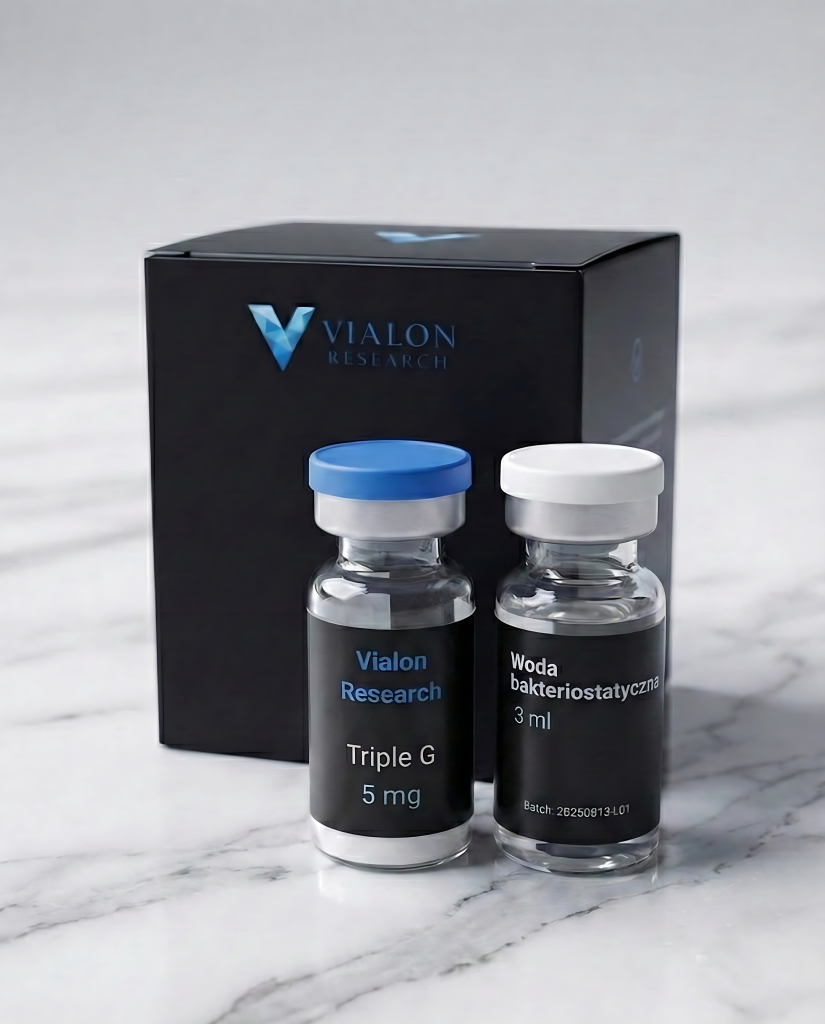
Triple agonist GLP-1/GIP/GCGR · 39 amino acids · CAS 2381089-83-2
| Parameter | Value |
|---|---|
| Molecular formula | C₂₂₁H₃₄₂N₄₆O₆₈ |
| Molecular weight | ~4731 Da |
| Amino acid count | 39 |
| CAS number | 2381089-83-2 |
| PubChem CID | 171390338 |
| Physical form | White lyophilized powder |
| Purity | >98% (RP-HPLC) |
| Classification | Chemical reagent / research material |
| Intended use | For in vitro research use only, not for use in humans or animals |
Not classified as a hazardous substance under CLP regulation. Offered as a chemical reagent for in vitro laboratory use, within the framework of applicable European Union chemical substances regulations (REACH, CLP).
Reconstitution and storage conditions:
Typical analytical equipment:
All working parameters should be selected according to the research laboratory’s internal protocol. Product intended exclusively for in vitro and analytical use; not for human or animal use.
Retatric Triple G is a synthetic 39-amino acid peptide with triple receptor affinity, designed as a simultaneous agonist of three class B1 GPCR receptors: GLP-1R, GIPR, and GCGR (the third incretin receptor). The base sequence derives from native GIP(1-42) with strategic modifications enabling cross-activation of all three receptors. Three non-coded amino acids (Aib at positions 2 and 20, alpha-methyl-leucine at position 13) confer a helical conformation optimal for simultaneous recognition by the three distinct ECD domains of the target receptors. A C20 diacyl fatty acid at position Lys20 provides albumin binding.
In radioligand binding studies (in vitro), Retatric demonstrates balanced affinity across all three receptors, with EC50 values in the nanomolar range. While GLP-1R and GIPR activation is shared with the dual agonist Tirzepic, the additional GCGR affinity distinguishes Retatric as the only available incretin triagonist. The molecular weight (~4731 Da) is lower than that of Tirzepic (~4813 Da) despite an analogous sequence length (39 aa), reflecting differences in amino acid and lipid modifications.
All three target receptors of Retatric (GLP-1R, GIPR, GCGR) belong to the secretin receptor family (class B1 GPCR) and share an identical primary effector pathway: Gs protein coupling, adenylyl cyclase activation, and intracellular cAMP elevation. The critical difference lies in the tissue distribution of the third receptor.
The GCGR receptor is predominantly expressed in hepatocytes, where it plays a central role in glycogen metabolism regulation and gluconeogenesis. To a lesser extent, GCGR is also present in the kidneys, heart, and select CNS structures. GCGR activation by an agonist leads to rapid cAMP elevation in hepatocytes, triggering a PKA cascade resulting in phosphorylation of glycogen phosphorylase and glycogen synthase. In in vitro experiments on primary rat hepatocyte cultures, multi-fold increases in cAMP production were observed following GCGR stimulation compared to basal levels.
The triple activation profile means that in an experiment involving a mixture of cells with varied receptor expression, Retatric activates the cAMP pathway in pancreatic beta cells (GLP-1R + GIPR), adipocytes (GIPR), osteoblasts (GIPR), hepatocytes (GCGR), cardiomyocytes (GLP-1R), and neurons (GLP-1R + GIPR). This broad cellular activation is a unique feature of triagonists compared to mono- and dual analogs.
Finan B et al. (2015) [1] described the rational design process of a monomeric peptide with triple affinity for GLP-1R, GIPR, and GCGR receptors. The paper presented a sequence strategy based on using the native GIP backbone as a platform, into which amino acid modifications were introduced to enable cross-activation of two additional receptors. The authors characterized the radioligand binding profile demonstrating nanomolar affinity for all three target receptors. In cellular assays using HEK293 lines overexpressing individual receptors, cAMP cascade activation through each of the three Gs pathways was demonstrated.
Day JW et al. (2009) [2] presented the first study describing rational design of a single peptide simultaneously activating GLP-1R and GIPR receptors. The authors employed an approach based on the native GIP sequence, introducing amino acid substitutions at key positions responsible for receptor selectivity. This work established the methodological foundation upon which subsequent triagonist studies expanding activation to the GCGR receptor were built.
Authier F and Bhatt Desai R (2008) [3] published a detailed review of GCGR receptor biology, covering receptor structure, the Gs/cAMP/PKA signaling pathway in hepatocytes, and mechanisms of internalization and recycling. The authors described the dominant expression of GCGR in the liver and its role in regulating glycogen phosphorylase and glycogen synthase activity through PKA-dependent phosphorylation.
Brubaker PL and Drucker DJ (2004) [4] presented a comparative analysis of signaling pathways activated by class B1 GPCR receptors from the incretin family. The study systematically compared cAMP production kinetics, beta-arrestin recruitment, and receptor desensitization for GLP-1R, GIPR, and GCGR in response to native ligands.
Receptor profile comparison of Retatric Triple G with the monoagonist Sematic GLP-1 and the dual agonist Tirzepic GLP-1 + GIP:
| Parameter | Sematic GLP-1 | Tirzepic GLP-1 + GIP | Retatric Triple G |
|---|---|---|---|
| Target receptors | GLP-1R | GLP-1R + GIPR | GLP-1R + GIPR + GCGR |
| Agonism type | Monoagonist | Dual agonist | Triple agonist |
| Amino acid count | 31 | 39 | 39 |
| Base sequence | GLP-1(7-37) | Native GIP | Native GIP (modified) |
| Non-coded amino acids | 1 (Aib2) | 1 (Aib2) | 3 (Aib2, Aib20, aMeL13) |
| Lipid modification | C18 acylation | C20 acylation | C20 acylation |
| Hepatocyte activation (GCGR) | No | No | Yes |
| Molecular weight | ~4113 Da | ~4813 Da | ~4731 Da |
Retatric Triple G is supplied as a lyophilized powder with purity above 98% (RP-HPLC). Store in dry form at -20°C to -80°C for stability of at least 24 months. After reconstitution in sterile water, store at 2-8°C and use within 30 days. Avoid repeated freeze-thaw cycles.
A detailed characterization of triple receptor affinity GLP-1/GIP/GCGR, preclinical data, and comparison with mono- and dual agonists is available in our knowledge base. Learn more about GLP-1 and GIP signaling mechanisms in our article GLP-1 and GIP: Incretin Signaling Mechanisms.
This product is a chemical raw material intended exclusively for in vitro research, scientific, and analytical applications. It is not intended for human or veterinary use, including for diagnostic, therapeutic, prophylactic, or nutritional purposes.
This product is not classified as a hazardous substance under CLP Regulation (EC) No 1272/2008. It is offered as a chemical reagent within the framework of applicable European Union chemical substances regulations (REACH, CLP). It does not constitute a medicinal product, dietary supplement, medical device, or cosmetic within the meaning of applicable laws.
Unused material should be disposed of in accordance with local regulations on chemical waste. Under laboratory conditions: neutralize and dispose with laboratory waste streams. Do not discharge into sewage systems.
This product is offered in accordance with applicable European Union regulations on chemical substances (REACH, CLP) and Polish law governing the trade of chemical reagents and research materials. Full terms of sale and product classification are set out in the Terms of Service.
By placing an order, the Customer confirms having read the above information and accepts the provisions of the Terms.
For questions regarding handling or regulatory information: [email protected].
Verified customer reviews for this product
Szybka dostawa,szybki kontakt z sprzedawcą,polecam!
Ok
Produkt zgodny z opisem. Wysoka jakość, wszystko przebiegło bez problemów.
Wszystko super. Szybka realizacja i profesjonalne
TL;DR: Laboratory analysis results can differ even for the same test material, because methods such…
TL;DRThis article explains how HPLC/MS is widely used as a set of laboratory analytical methods…
Reading a COA requires verifying the batch, analytical methods, acceptance criteria, and test results.
Retatric Triple G is a synthetic peptide with triple agonistic activity, binding simultaneously to three receptors: GLP-1R, GIPR, and GCGR. The amino acid sequence was designed to achieve balanced affinity across all three incretin receptors.
Monoagonists (e.g., GLP-1 analogs) activate one receptor. Dual agonists (GLP-1R + GIPR) activate two. Triple G is a triple agonist that additionally activates the GCGR receptor, which in preclinical studies has demonstrated synergistic effects on metabolic pathways beyond GLP-1R signaling alone.
Store the lyophilized peptide at -20°C to -80°C in a sealed vial, away from light and moisture. After reconstitution in sterile water, store at 2-8°C for up to 30 days. Avoid repeated freeze-thaw cycles.
Each batch undergoes HPLC purity analysis (≥98%) and molecular weight verification by mass spectrometry (MS). Results confirm purity above 98%. Certificate of Analysis is included with every order.
Retatric Triple G is available in 5 mg, 10 mg, and 15 mg lyophilized vials. The choice of variant depends on the scale of the planned experiment and the required working concentration in the research protocol.