
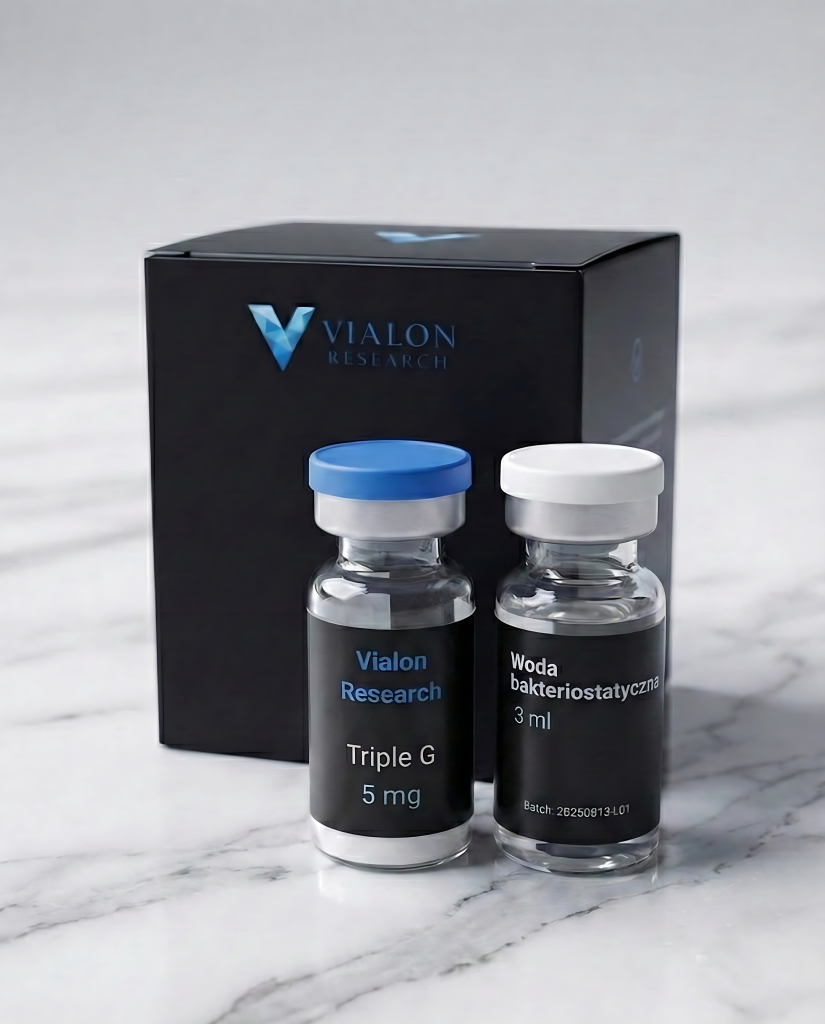
Note: This article is for educational purposes only and is based on peer-reviewed scientific literature. The peptides described are available exclusively as reagents for laboratory research (research use only). This article does not constitute medical advice or instructions for use.
Introduction
The development of peptide analogs has progressed incrementally — from GLP-1R peptides, through dual GLP-1R/GIPR peptides, to the latest generation of molecules simultaneously activating three receptors. Triple agonism, additionally encompassing GCGR (the GCGR receptor), represents an active and rapidly evolving area of metabolic research. While the mechanisms of GLP-1 and GIP have been described in detail in our article on incretin peptide signaling, this text focuses on the third component — GCGR — and what it brings to the concept of triple agonism.
From Dual to Triple Agonism
Dual GLP-1R/GIPR peptides, such as Tirzepic GLP-1 + GIP, combine two complementary pathways: GLP-1R is responsible for modulating glucose-dependent insulin secretion and satiety signaling in the CNS, while GIPR participates in lipid metabolism regulation and fatty acid uptake by adipocytes. In preclinical studies, the dual approach demonstrated stronger metabolic effects than GLP-1R analogs alone (Willard et al., 2020).
Triple agonism goes one step further — it adds GCGR activation, a receptor with a fundamentally different metabolic profile. While GLP-1R and GIPR primarily modulate the anabolic axis (insulin secretion, energy substrate storage), GCGR activates catabolic processes: it increases energy expenditure, stimulates lipolysis, and activates thermogenesis in brown adipose tissue (BAT). This is not simply the sum of three effects — combining the anabolic axis with the catabolic one creates a synergy that cannot be achieved by activating the receptors separately (Coskun et al., 2022).
GCGR — The Third Receptor
GCGR (the GCGR receptor), like GLP-1R and GIPR, belongs to class B G protein-coupled receptors (GPCRs). This receptor is expressed primarily in hepatocytes, but also in brown adipose tissue, kidneys, and the heart. The endogenous ligand is a 29-amino acid peptide secreted by alpha cells of the pancreatic islets of Langerhans.
In the context of metabolic research, GCGR activation initiates several key signaling cascades:
- Thermogenesis in BAT: GCGR signaling stimulates expression of UCP1 (uncoupling protein 1) in brown adipocytes, increasing energy dissipation as heat. In mouse studies, GCGR activation led to measurable increases in body temperature and energy expenditure (Habegger et al., 2010).
- Lipolysis and fatty acid oxidation: GCGR stimulates triacylglycerol breakdown in the liver and adipose tissue, directing released fatty acids to beta-oxidation — a process where they are utilized as energy substrates.
- Hepatocyte regulation: In hepatocytes, GCGR activation stimulates glycogenolysis and gluconeogenesis, increasing hepatic glucose production. In the context of a triple agonist peptide, this effect is counterbalanced by simultaneous GLP-1R activation, which stimulates insulin secretion and prevents excessive glycemic increases.
- Amino acid regulation: In animal models, GCGR activation reduces plasma amino acid concentrations, suggesting increased hepatic protein catabolism — a mechanism linked to liver mass regulation (Finan et al., 2015).
A crucial aspect is that isolated GCGR activation would lead to hyperglycemia (through stimulation of hepatic glucose production). Only the simultaneous activation of GLP-1R — which stimulates insulin secretion and slows gastric emptying — neutralizes this effect, allowing safe utilization of GCGR’s catabolic properties under experimental conditions.
Molecular Structure of Retatric Triple G
Retatric Triple G is a synthetic, linear peptide consisting of 39 amino acids, based on the native GIP peptide backbone. The molecular architecture was designed to provide balanced affinity for three receptors — GLP-1R, GIPR, and GCGR — while maintaining resistance to enzymatic degradation.
Key structural modifications:
- Aib at positions 2 and 20 — α-aminoisobutyric acid (Aib) at position 2 provides resistance to proteolytic cleavage by dipeptidyl peptidase-4 (DPP-4), the enzyme responsible for rapid degradation of native GIP and GLP-1 peptides. The second Aib at position 20 stabilizes the α-helix in the central peptide region.
- αMeL at position 13 — α-methyl-leucine increases conformational rigidity of the peptide chain, limiting flexibility that could weaken receptor interactions.
- C20 fatty acid acylation — attachment of a 20-carbon lipid chain enables binding to plasma albumin, creating a circulating reservoir. This mechanism extends the half-life from minutes (native GIP/GLP-1 peptides) to hours under in vivo conditions (Coskun et al., 2022).
Together, three non-coded amino acids (Aib×2, αMeL×1) and the lipid modification provide a pharmacokinetic profile suitable for research protocols with single administration.
Preclinical Research Data
Fundamental studies on triple agonist peptides have been published in several leading scientific journals:
Coskun et al. (2022), Nature: In a landmark study on diet-induced obese (DIO) mice, a triple agonist peptide demonstrated ~30% body weight reduction over 4 weeks, surpassing both the GLP-1R peptide and the dual GLP-1R/GIPR peptide under comparable experimental conditions. The effect was attributed to additional GCGR activation, leading to increased energy expenditure and thermogenesis.
Liu et al. (2024), Cell Discovery: Crystallographic analysis revealed the mechanism by which a single molecule achieves affinity for three structurally similar but functionally distinct receptors. The N-terminal region (positions 1-7) plays a key role in determining selectivity for GCGR.
Finan et al. (2015), Nature Medicine: Earlier studies on triple agonist peptides demonstrated glycemia normalization, improved insulin sensitivity, and reduction of hepatic steatosis in DIO and db/db mouse models. Reductions in cholesterol and triacylglycerol levels were also observed.
Bossart et al. (2022), Journal of Medicinal Chemistry: A review of design strategies for triple agonist peptides, including selection of amino acid modification positions and optimization of the binding profile for three receptors simultaneously.
Research Applications
Triple peptide agonism opens new research possibilities not offered by mono or dual agonist peptides. In experimental protocols using Retatric Triple G, the following readouts are particularly relevant:
- Energy expenditure: Measurement via indirect calorimetry (VO₂, VCO₂) — specific to the GCGR component, not observed with GLP-1R peptides alone.
- BAT activity: Interscapular temperature (IR thermography) or ¹⁸F-FDG uptake on PET — a direct marker of thermogenesis activation through GCGR.
- Body temperature: Measurable increase (0.3-0.8°C in mouse models) as an indicator of thermogenic pathway activation.
- Lipid profile: Hepatic triacylglycerols, cholesterol, free fatty acids — the GCGR component accelerates lipolysis and beta-oxidation.
Frequently Asked Questions (FAQ)
How does a triple agonist peptide differ from a dual agonist?
A dual GLP-1R/GIPR peptide (e.g., Tirzepic GLP-1 + GIP) activates two receptors: GLP-1R (insulin secretion, satiety) and GIPR (lipid metabolism). A triple agonist peptide additionally activates the GCGR receptor, responsible for energy expenditure, BAT thermogenesis, and lipolysis. This is an additional catabolic component absent from dual agonist peptides.
Why is GCGR activation important in metabolic research?
GCGR controls catabolic processes — it increases energy expenditure, stimulates thermogenesis in brown adipose tissue, and promotes lipolysis. Combined with GLP-1R (which neutralizes the potential hyperglycemic effect), it provides a unique tool for studying the synergy of anabolic and catabolic pathways in a single experimental model.
How should Retatric Triple G be stored?
The lyophilized peptide should be stored at ≤ -20°C. After reconstitution in bacteriostatic water, stability at 2-8°C is 14-21 days. Minimize freeze-thaw cycles.
Is triple agonism simply the sum of three separate effects?
No. Preclinical studies indicate a synergistic rather than additive effect. Isolated GCGR activation would lead to hyperglycemia (increased hepatic glucose production), but simultaneous GLP-1R activation neutralizes this effect through insulin stimulation. Similarly, GIPR and GCGR affect lipid metabolism through different pathways — GIPR promotes uptake while GCGR promotes lipolysis — creating a regulated balance that could not be achieved by simply combining three separate peptides.
Bibliography
- Coskun T et al. (2022). „LY3437943, a novel triple GIP, GLP-1, and GCGR receptor agonist for glycemic control and weight loss: From discovery to clinical proof of concept.” Cell Metabolism, 34(9), 1234-1247. doi:10.1016/j.cmet.2022.07.013
- Liu B et al. (2024). „Structural insights into the activation of GLP-1R, GIPR, and GCGR by a triple agonist peptide.” Cell Discovery, 10, 48. doi:10.1038/s41421-024-00672-9
- Finan B et al. (2015). „A rationally designed monomeric peptide triagonist corrects obesity and diabetes in rodents.” Nature Medicine, 21, 27-36. doi:10.1038/nm.3761
- Bossart M et al. (2022). „Effects on weight loss and glycemic control with SAR441255, a potent unimolecular peptide GLP-1/GIP/GCG receptor triagonist.” Cell Metabolism, 34(1), 59-74. doi:10.1016/j.cmet.2021.12.005
- Habegger KM et al. (2010). „The metabolic actions of GCGR revisited.” Nature Reviews Endocrinology, 6(12), 689-697. doi:10.1038/nrendo.2010.187
- Willard FS et al. (2020). „Tirzepatide is an imbalanced and biased dual GIP and GLP-1 receptor agonist.” JCI Insight, 5(17). doi:10.1172/jci.insight.140532
- Nauck MA, Meier JJ (2021). „Incretin hormones: Their role in health and disease.” Diabetes, Obesity and Metabolism, 20(Suppl 1), 5-21. PMC8168943