Variability of HPLC and MS Laboratory Analysis Results
TL;DR: Laboratory analysis results can differ even for the same test material, because methods such…

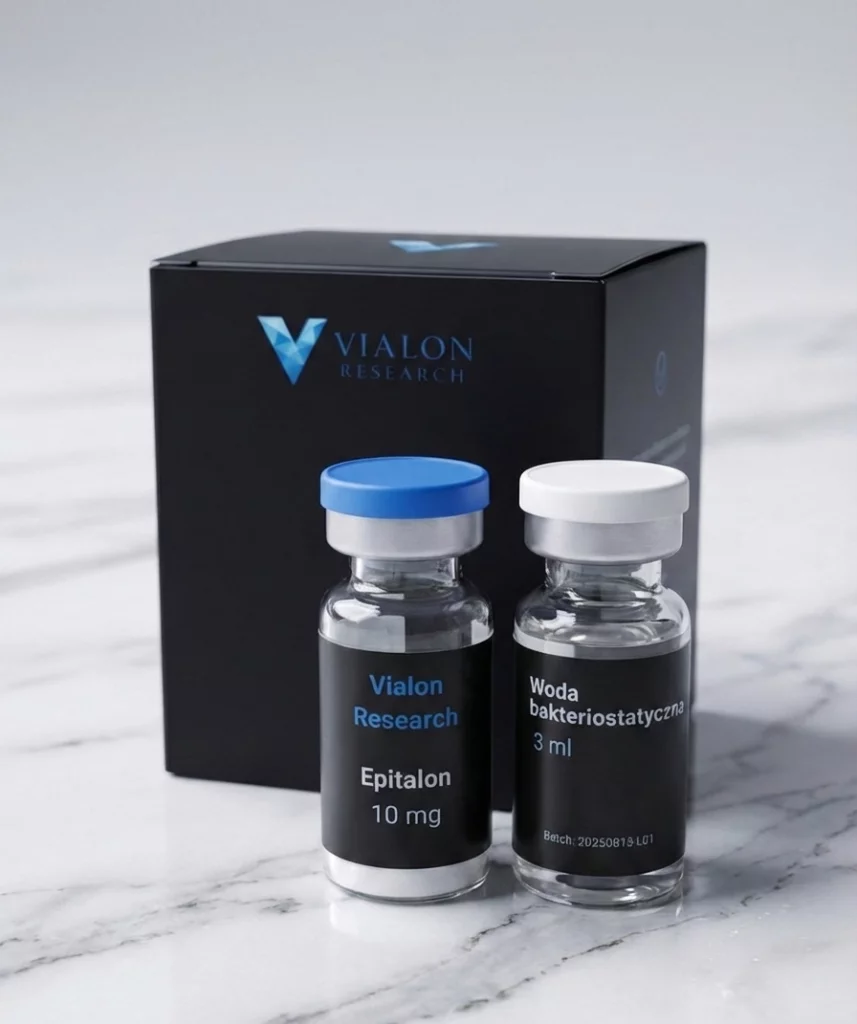
Tetrapeptide · telomerase regulator · CAS 307297-39-8
| Parameter | Value |
|---|---|
| Molecular formula | C₁₄H₂₂N₄O₉ |
| Molecular weight | ~390.35 Da |
| Amino acid count | 4 (tetrapeptide) |
| Sequence | Ala-Glu-Asp-Gly (AEDG) |
| CAS number | 307297-39-8 |
| PubChem CID | 219042 |
| Physical form | White lyophilized powder |
| Purity | ≥98% (RP-HPLC) |
| Classification | Chemical reagent / research material |
| Intended use | For in vitro research use only, not for use in humans or animals |
Not classified as a hazardous substance under CLP regulation. Offered as a chemical reagent for in vitro laboratory use, within the framework of applicable European Union chemical substances regulations (REACH, CLP).
Reconstitution and storage conditions:
Typical analytical equipment:
All working parameters should be selected according to the research laboratory’s internal protocol. Product intended exclusively for in vitro and analytical use; not for human or animal use.
Epitalon (also known as Epithalon or Epithalone) is a synthetic tetrapeptide with the sequence Ala-Glu-Asp-Gly (AEDG), developed as an analog of epithalamine, a peptide extract isolated from bovine pineal gland. The peptide was designed by Prof. Vladimir Khavinson's team at the Institute of Bioregulation and Gerontology in Saint Petersburg as part of a peptide bioregulator research program.
With a molecular weight of ~390.35 Da, Epitalon is among the smallest biologically active peptides described in the literature. The AEDG sequence consists exclusively of four L-amino acids without post-translational modifications. Compared to epithalamine, which is a heterogeneous peptide mixture, Epitalon is a chemically defined compound with reproducible physicochemical properties.
The primary area of research interest is Epitalon's effect on telomerase activity. In experiments on human fibroblasts and CD8+ lymphocytes, the AEDG peptide was shown to induce expression of the catalytic subunit of telomerase (hTERT). The proposed mechanism involves regulation of hTERT gene expression at the transcriptional level, although the detailed signaling pathways have not been fully characterized.
A second research direction is Epitalon's interaction with pineal gland function. In aged rat models, modulation of melatonin production was observed following exposure to the AEDG peptide. These results align with the hypothesis that short regulatory peptides can influence neuroendocrine functions in animal models.
Most data comes from in vitro studies on cell cultures and experiments on rodent models. The molecular mechanisms remain a subject of active investigation.
The foundational work is Khavinson's 2002 monograph, published as a special edition of Neuroendocrinology Letters [1]. The author summarized a long-term research program encompassing characterization of peptides isolated from various tissues, including the pineal gland.
Khavinson, Bondarev, and Butyugov (2003) published in Bulletin of Experimental Biology and Medicine (135(6):590-592) results of experiments in which the AEDG peptide induced telomerase activity and telomere elongation in human fibroblasts and CD8+ lymphocytes [2]. An increase in hTERT expression correlating with increased telomeric fragment length was demonstrated.
Anisimov, Khavinson, et al. (2002) investigated the effect of Epitalon on a 1,2-dimethylhydrazine-induced colon carcinogenesis model in rats. The paper in Cancer Letters (183(1):1-8) described the peptide's inhibitory effect on tumor development in this experimental model [3].
Epitalon is a tetrapeptide with a mass of just ~390 Da — one of the shortest peptides in our catalog:
Selected publications on the AEDG tetrapeptide Epitalon.
"Epithalon peptide induces telomerase activity and telomere elongation in human somatic cells"
Bulletin of Experimental Biology and Medicine, 135(6):590-592
"Effect of Epitalon on biomarkers of aging, life span and spontaneous tumor incidence in female Swiss-derived SHR mice"
Biogerontology, 4(4):193-202
This product is a chemical raw material intended exclusively for in vitro research, scientific, and analytical applications. It is not intended for human or veterinary use, including for diagnostic, therapeutic, prophylactic, or nutritional purposes.
This product is not classified as a hazardous substance under CLP Regulation (EC) No 1272/2008. It is offered as a chemical reagent within the framework of applicable European Union chemical substances regulations (REACH, CLP). It does not constitute a medicinal product, dietary supplement, medical device, or cosmetic within the meaning of applicable laws.
Unused material should be disposed of in accordance with local regulations on chemical waste. Under laboratory conditions: neutralize and dispose with laboratory waste streams. Do not discharge into sewage systems.
This product is offered in accordance with applicable European Union regulations on chemical substances (REACH, CLP) and Polish law governing the trade of chemical reagents and research materials. Full terms of sale and product classification are set out in the Terms of Service.
By placing an order, the Customer confirms having read the above information and accepts the provisions of the Terms.
For questions regarding handling or regulatory information: [email protected].
Verified customer reviews for this product
Wszystko ok, dobrze zabezpieczone
TL;DR: Laboratory analysis results can differ even for the same test material, because methods such…
TL;DRThis article explains how HPLC/MS is widely used as a set of laboratory analytical methods…
Reading a COA requires verifying the batch, analytical methods, acceptance criteria, and test results.
Epitalon (also Epithalon) is a synthetic tetrapeptide with the sequence Ala-Glu-Asp-Gly (AEDG). It is a synthetic analog of epithalamine, a hormone produced by the pineal gland. CAS: 307297-39-8.
Epitalon is one of the shortest bioactive peptides in research — just 4 amino acids. Studies by Prof. Vladimir Khavinson have investigated its interaction with telomerase activity in cell culture models.
Store the lyophilized peptide at -20°C to -80°C. After reconstitution in sterile water, store at 2-8°C and use within 30 days.
Epitalon is available as a 10 mg lyophilized vial.
Every batch undergoes RP-HPLC analysis (≥98%) and mass spectrometry verification. Certificate of Analysis included.