Disclaimer: The following article is for educational and informational purposes only. The substances described are intended for research and laboratory use only. This does not constitute medical advice or an encouragement to use in humans or animals.
Introduction
BPC-157 (Body Protection Compound-157) is a synthetic pentadecapeptide consisting of 15 amino acids with the sequence Gly-Glu-Pro-Pro-Pro-Gly-Lys-Pro-Ala-Asp-Asp-Ala-Gly-Leu-Val. It is a fragment of a naturally occurring protective protein found in human gastric juice (BPC — Body Protection Compound), first described in research on the cytoprotective properties of gastric content in the 1990s.
Unlike most research peptides, BPC-157 exhibits remarkable stability in low-pH environments — a characteristic inherited from its parent gastric juice protein. This property makes it one of the few research peptides that do not undergo immediate degradation under acidic conditions.
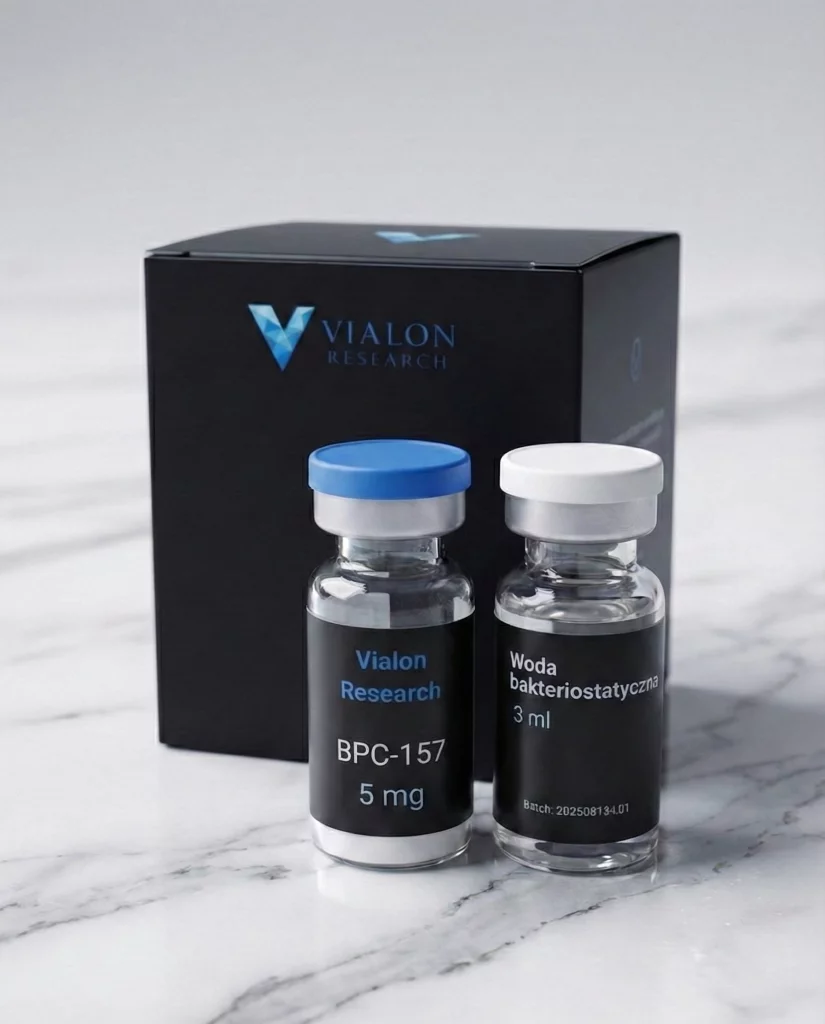
Our store offers research-grade BPC-157 in lyophilized form with purity ≥98% HPLC, as well as a TB-500 + BPC-157 blend combining two regenerative peptides in a single vial.
Molecular Structure and Physicochemical Properties
BPC-157 is a peptide with a molecular weight of ~1419.5 Da and the molecular formula C₆₂H₉₈N₁₆O₂₂ (CAS number: 137525-51-0). The sequence GEPPPGKPADDAGLV contains three consecutive proline residues (positions 3-5), which confer conformational rigidity typical of polyproline II (PPII) structures.
Key structural features:
- Absence of cysteine and methionine — eliminates susceptibility to sulfur residue oxidation, the primary cause of degradation in many peptides (e.g., Met²⁷ oxidation in native GHRH)
- Triproline motif (PPP) — stabilizes secondary structure and limits susceptibility to enzymatic proteolysis
- Lysine residue (Lys⁷) — the only basic residue, likely the site of interaction with target proteins
- Stability at pH 2-10 — a rare characteristic among research peptides, resulting from the absence of labile acid-base bonds in the sequence
For more on peptide degradation mechanisms and the role of amino acid sequence in stability, see our knowledge base articles on peptide stability.
Molecular Mechanisms
Despite over 100 published in vitro and in vivo studies, the exact molecular mechanism of BPC-157 has not been fully elucidated. Current research points to a multi-pathway mode of action for this pentadecapeptide.
Nitric Oxide (NO) Pathway
Numerous studies indicate an interaction between BPC-157 and the nitric oxide (NO) system. In animal models, modulation of nitric oxide synthase (NOS) activity was observed — both endothelial (eNOS) and inducible (iNOS). BPC-157 appears to maintain NO homeostasis: in states of deficiency it increases NO production, while in states of excess (e.g., after L-NAME or L-arginine administration) it restores balance. This bidirectional regulation distinguishes it from simple NO donors or inhibitors.
Growth Factors
In research models, BPC-157 influenced the expression of key growth factors:
- VEGF (vascular endothelial growth factor) — increased expression, correlating with the observed proangiogenic effect
- EGF (epidermal growth factor) — enhancement of the EGF-R/ERK1/2 pathway
- FGF (fibroblast growth factor) — activation of fibroblast proliferation in vitro
Dopaminergic System
A series of studies by Sikiric and colleagues demonstrated an interaction between BPC-157 and dopamine D2 receptors. In animal models, the peptide modulated the effects of dopaminergic agonists and antagonists, suggesting its involvement in dopaminergic neurotransmission. This mechanism is the subject of ongoing research and may explain the observed neuroprotective effects.
Major Research Areas
Gastroprotection
Gastroprotection is historically the first and best-documented research area for BPC-157. In animal models, the peptide demonstrated cytoprotective properties toward the gastric mucosa damaged by alcohol, NSAIDs (nonsteroidal anti-inflammatory drugs), acids, and bases. These studies relate to the original discovery of the BPC protein in gastric juice — the peptide appears to retain the protective properties of the parent protein.
Tissue Regeneration
In vivo studies in animal models describe the effects of BPC-157 in the context of regeneration:
- Tendons and ligaments — accelerated healing in rat Achilles tendon transection models
- Muscles — modulation of regeneration after mechanical and chemical injury
- Bones — influence on bone callus formation in fracture models
- Skin — accelerated wound closure in burn and surgical wound models
The common mechanism in these models appears to be angiogenesis stimulation (formation of new blood vessels) through the VEGF pathway and modulation of the inflammatory response. These properties place BPC-157 in the category of regenerative peptides alongside TB-500 (thymosin β4 fragment) and GHK-Cu (copper tripeptide), although the molecular mechanisms of each are distinct.
Neuroprotection
A growing body of literature describes the neuroprotective potential of BPC-157 in preclinical models. Studies encompass models of spinal cord injury, cerebral ischemia, and drug-induced neurotoxicity (e.g., haloperidol, methamphetamine). Observed effects include modulation of the dopaminergic, serotonergic, and GABAergic systems, suggesting broad involvement of BPC-157 in central neurotransmission.
BPC-157 vs TB-500 — Comparing Regenerative Peptides
BPC-157 and TB-500 are two of the most widely studied peptides in the context of regenerative processes. Although both are classified as regenerative peptides, they differ significantly in terms of structure, origin, and mechanism of action.
BPC-157 (15 amino acids, ~1419 Da) originates from a protective gastric juice protein and acts primarily through modulation of the NO pathway and growth factors (VEGF, EGF). It is stable at acidic pH and exhibits gastroprotective properties.
TB-500 (43 amino acids, ~4963 Da) is a fragment of thymosin β4 that acts by binding monomeric G-actin and promoting F-actin polymerization. This mechanism is crucial for cell migration and cytoskeletal reorganization.
The complementarity of mechanisms means both peptides are frequently studied together. Our catalog offers a ready-made TB-500 + BPC-157 blend in a 1:1 ratio, eliminating the need to prepare two separate solutions.
Storage and Stability of BPC-157
BPC-157’s stability is exceptional compared to other research peptides, which results from the absence of labile amino acid residues (cysteine, methionine, tryptophan) in its sequence:
- Lyophilized form: store at ≤ -20°C, protected from moisture and light. Stability exceeds 24 months.
- After reconstitution: solution in bacteriostatic water should be stored at 2-8°C and used within 14 days.
- pH stability: BPC-157 retains activity across pH 2-10 — a unique characteristic among research peptides, allowing studies under acidic conditions (e.g., modeling the gastric environment).
For a detailed guide on peptide storage conditions, see our knowledge base articles on peptide handling best practices.
Frequently Asked Questions
What is BPC-157?
BPC-157 (Body Protection Compound-157) is a synthetic pentadecapeptide of 15 amino acids (sequence: GEPPPGKPADDAGLV), derived from a human gastric juice protective protein. CAS number: 137525-51-0, molecular weight ~1419.5 Da. It is one of the most intensively studied peptides in the context of regenerative processes.
What is the mechanism of action of BPC-157?
BPC-157 acts through multiple pathways — it modulates the nitric oxide (NO) system, influences growth factors (VEGF, EGF, FGF), and interacts with dopamine D2 receptors. The exact molecular mechanism has not been fully described, but over 100 publications document its effects in preclinical models.
How does BPC-157 differ from TB-500?
BPC-157 (15 aa, ~1419 Da) originates from a gastric protein and acts through the NO/VEGF pathway. TB-500 (43 aa, ~4963 Da) is a thymosin β4 fragment that acts by binding G-actin. The peptides have complementary mechanisms — also available as a TB-500 + BPC-157 blend.
Why is BPC-157 stable at acidic pH?
BPC-157’s stability results from the absence of labile amino acid residues (cysteine, methionine, tryptophan) in its sequence and the presence of a polyproline II motif (three consecutive prolines at positions 3-5), which stabilizes the peptide’s secondary structure.
How should BPC-157 be stored?
Store the lyophilized form at ≤ -20°C (stability >24 months). After reconstitution in bacteriostatic water, store at 2-8°C and use within 14 days. Do not freeze after reconstitution.
Bibliography
- Sikiric P et al. (2018). „Brain-gut Axis and Pentadecapeptide BPC 157: Theoretical and Practical Implications.” Curr Neuropharmacol, 16(5):505-516. doi:10.2174/1570159X15666170828130411
- Seiwerth S et al. (2014). „BPC 157’s effect on healing.” J Physiol Pharmacol, 65(2):177-185.
- Sikiric P et al. (2014). „Pentadecapeptide BPC 157 and its effects on a NSAID toxicity model.” Eur J Pharmacol, 740:340-345. doi:10.1016/j.ejphar.2014.07.018
- Chang CH et al. (2011). „The promoting effect of pentadecapeptide BPC 157 on tendon healing involves tendon outgrowth, cell survival, and cell migration.” J Appl Physiol, 110(3):774-780. doi:10.1152/japplphysiol.00945.2010
- Sikiric P et al. (2013). „Stable gastric pentadecapeptide BPC 157 in trials for inflammatory bowel disease.” Curr Pharm Des, 19(1):76-83.
- Staresinic M et al. (2006). „Gastric pentadecapeptide BPC 157 accelerates healing of transected rat Achilles tendon and in vitro stimulates tendocytes growth.” J Orthop Res, 24(5):1012-1020. doi:10.1002/jor.20129
- Sikiric P et al. (2016). „Pentadecapeptide BPC 157 interactions with dopamine system.” Curr Pharm Des, 22(40):6105-6113.